The International Bach Chamber Music Festival

Dear friends of Bach music! I am glad that the festival of the immortal J. S. Bach is approaching again. The German composer whose creations belong to the whole mankind gives mental force to every listener. His music knows no barriers among countries and nations; it has the power of bringing together both listeners and performers.
It is already the 19th time when the Bach Music Foundation invites everybody to festival concerts and master classes - everybody who wishes to endow their souls with the touch of immortality.
Let us all have a nice celebration!
Aina Kalnciema
President of the Bach Music Foundation
About
Music causes vibrations in the human body. Some kinds of sounds help to heal the crystalline structure of the human organism at the level of cells. That is one of the reasons why The entire world is still passionate about the life and music of the great Baroque master Johann Sebastian Bach. There are Bach societies and Bach interest clubs all over the world - too many to count up. Bach's music contains energy, joy and vitality which encourages people to think about the great composer, to discuss him, to share opinions about him. The bottom line is that people want to be with Bach.
The International Bach Chamber Music Festival is focussed on the intimate, the soulful, the personal. It manifests the producers' desire to reveal Bach from the "quiet side" and show that the relatively few sounds in a chamber music score can say just as much in the way of fundamental ideas, thoughts and content as Bach's major vocal and symphonic compositions.
The concept of the Festival strives to embrace a wealth of aesthetic, cultural and historical values. For one thing, audiences at the festival hear seldom performed interpretations of Bach's chamber music, including the compositions that were produced by the great artist's sons and contemporaries, as well as the music inspired by Bach's personality. The festival is also a cradle for new music - each year there are new works commissioned especially for the festival.
The International Bach Chamber Music Festival also organises master classes for students and professionals.
The festival is member of European Early Music Network REMA since 2006.
Aina Kalnciema has done her very best with the Bach Musical Society, and she has brought it up to the international level. Preparing for its centennial celebration, an organisation in Leipzig, Germany, that is called the "Neue Bachgesellschaft", started to collect information about Bach-related organisations throughout the world. It came across the Bach Musical Society in Latvia, and today the Latvian society is a full-fledged participant in the global network of Bach-related organisations.The organisation which once held quiet evenings of conversation, with music as means of communication and illustration, turned into a more ambitious project in 2001. The International Bach Chamber Music Festival was born, and the Bach Musical Society is the main arranger of the event, as well as the generator of creative artistic ideas for it.
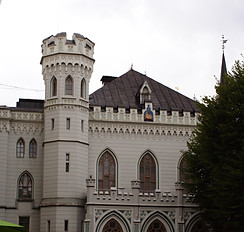
The concerts are always held in the venues which are entirely appropriate for them - historical buildings of Old Rīga: Great Guild Hall, Small Guild Hall, Art Museum Riga Bourse, Museum of Riga History and Navigation, St. John's Church, Riga Dome Cathedral, Menzendorff House.
The eighth concert locale is the Latvian Academy of Music. Students who are learning to play organ and harpsichord these participate in the concerts, and that is another aspect of the festival - it encourages the the young people to perform the works of Bach and his contemporaries at very distinguished concerts thus giving fresh interpretations of well known Baroque music.
The International Bach Chamber Music Festival also organises master classes for students and professionals.

Artists
LES MUFFATTI
![Muffatti-19[Stephane_Puopolo].jpg](https://static.wixstatic.com/media/afa904_0ab5a0151a2944df9572d514fa26fc57~mv2.jpg/v1/fill/w_647,h_307,al_c,q_80,usm_0.66_1.00_0.01,enc_avif,quality_auto/Muffatti-19%5BStephane_Puopolo%5D.jpg)
In 1996, a group of young Brussels-based musicians embarked on a collective musical adventure to address the challenges of coming together around baroque orchestral music.
Their credo: Deriving pleasure from working together, in a spirit of honesty, openness, curiosity and sharing; The joy of bringing classical music to our contemporaries and making ancient music accessible to all, to be appreciated for itself.
Their values: Collegiality, at all levels; The need to stimulate flourishing collaboration; Transmission to both the musicians and the public of tomorrow; Friendship, a gua- rantee of cohesion and quality.
A double approach: To shine a new light on the great masterpieces, thereby serving the renowned composers; To reveal, through in-depth musicological study, including that of published works and organology, as yet unpublished treasures of our musical heritage.
Artistic directionis assumed by a combination of the concertmaster, a soloist, and a guest conductor, depending on the demands of each project. On a more permanent basis, the orchestra’s overall artistic orientation, as well as the general lines of its unique strengths, are maintained by a trio of orchestral members, each contributing their own experience and ideas – as individuals, but also as indispensible and active links.
Just as the workshops of the master painters of the era, Les Muffatti is a research laboratory, a focus for synergies, with an open approach to historical city-life, to Europe and to the leading figures that span them.

Aina Kalnciema
Aina Kalnciema was born in Riga. Graduating (with honours) from piano and organ classes of St.Petersbourg Conservatory, she perfected her skills in harpsichord interpretation in Holland, France, Switzerland and Germany.
She has regulary performed as harpsichordist soloist, and has toured in all republic of the former Soviet Union, in the USA, Canada, Australia and Europien countries. She has performed with famous orchestras, conductors and soloists, such as the st. Petersbourg Philarmonic, Moscow virtuosos, Musica Viva, different chamber orchestras from Latvia, Lithuania, Estonia, Poland. Since 1998 she is member of Baltic Trio, which performs and records contemporary music for flute, cello and harpsichord written by composers from Baltic states.
A. Kalnciema participated in many Europian festivals and performed together with distinguish musicians from different countries ( J. Holloway, B. Skride, I. Monighetti, S. Preston, L. Duftschmidt, A. Mustonen, A. Rudin, O. Zoboli, A. Utkin, Massimo Mercelli Erik Bosgraaf, S.- L. Kaakinen-Pilch, Paolo Pandolfo and musicians from such ensembles as La Petite Bande, Musica Antiqua Koln, Les ArtsFlorissants, Hortus Musicus).


Prof. Aina Kalnciema leads harpsichord class at the Latvian Academy of Music, at the same time she is president of Bach Music Foundation. She is director of International Bach chamber Music Festivals in Latvia which she started on 2001. Aina Kalnciema has many recordings of early and contemporary music.
Aina Kalnciema was awarded Latvia`s Order of the Three Stars in 2008.
On 21 March 2011 Ms Aina Kalnciema in her capacity of the President of Bach Music Foundation and the Director of Bach Chamber Music Festival received the Annual Award of Riga City Council "the White Sparrow" for her significant contribution to the international cultural exchange through collaboration with outstanding and renowned artists worldwide.

Concerts & Programme



-
J.S.Bach (1685 – 1750) cantata
Liebster Jesu mein Verlangen ( BWV 32)
-
J.S.Bach Ouverture Nr.3 for baroque orchestra (BWV 1068)
-
J.K.Graupner (1683 – 1760)
Wo willst Du hin betrubte Seele (GWY 1155/09A)
-
J.K. Graupner Concerto for oboe d’amour or oboe (GWY 302, 313, OR324)
Liebster Jesu
-
J.S.Baha mūzika
Aina Kalnciema (harpsichord), Ainārs Paukšēns (viola da gamba),
Wolfgang Kraemer (blockflute), Agnieszka Kulowska (baroque violin)
-
Johann Sebastian Bach
-
Georg Philipp Telemann
-
Jan Dimas Zelenka
-
Heinrich Ignaz Franz Biber
-
Andrea Falconiero (1585-1656) Four Brandi (dances)
-
Giovanni Paolo Cima (1580-1630).
Sonata in g -
Carlo Gesualdo (1566-1613). Canzon francese del Principe (for harpsichord)
-
Antonio Vivaldi (1678-1741). Sonata in f major RV 46 for blockflute and b.c.
-
Benedetto Marcello (1686-1739). Sonata op.2 n.12 in f major for blockflute and b.c
-
Benedetto Marcello. Chiacona (la Stravaganza) for harpischord
-
Antonio Vivaldi. Sonata in g minor
op.13 n.6 from “Il Pastor Fido”
(attrib. to N. Chedeville(1705-1782)
for blockflute and b.c)
-
Reinhard FEBEL, Sieben Choralbearbeitungen nach Johann Sebastian
-
Ferrucio BUSONI, Finnländische Volksweisen, Op.27, BV 227

Our concert places